The build-or-buy dilemma in Feature Management
Organizations invest significant time, often months or even years, into modern application development life cycles. However, deployment can feel like a pivotal moment. While many Continuous Integration/Continuous Deployment (CI/CD) practices aim to simplify and reduce the stress of deployment by making it a regular occurrence, it can still pose substantial challenges and lead to various issues.
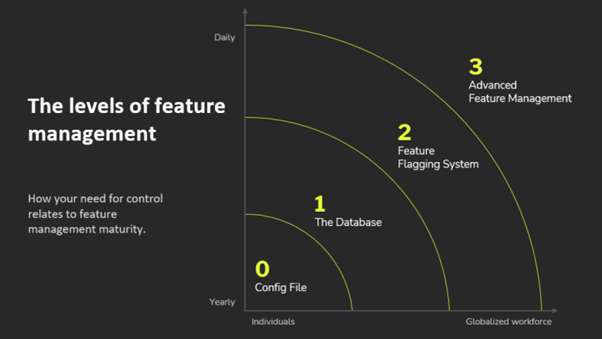
The build-or-buy decision in feature management can significantly impact development efficiency
Table of Contents
01 Introduction
To mitigate deployment challenges, some organizations recognize the advantages of separating code deployments from releases using a technique known as Feature Flagging. This approach allows for gradual and progressive rollouts, enabling changes to be tested with a limited user base in real-world scenarios without a full-scale launch.
However, it's not uncommon for organizations to opt for what seems like the easiest route: building feature flag capabilities in-house. While this initial enthusiasm may stem from a desire to customize the solution, it can quickly lead to frustration and complications, undermining the very goal of reducing deployment stress and risks.
02 Common Pain Points with Homegrown Feature Flags
Cross-team Development, Collaboration and Visibility
When an organization decides to create an in-house feature flag solution, it typically begins with a single team focused on their specific requirements. This approach makes it challenging to extend the solution to other teams, let alone achieve corporate-wide usage and standardization.
- • Homegrown systems often struggle to support multiple programming languages
- • Lack necessary access control and permissions for safety and security
- • Difficulty tracking the status of feature flags consistently
- • Underestimate effort required to create and maintain documentation
Maintenance and Governance
While developing a custom system may initially seem feasible, it comes with significant maintenance costs, especially as feature flags become a crucial component alongside core applications.
- • Any issues with homegrown solutions can lead to outages
- • Adds another layer of complexity to the application platform
- • Requires thorough monitoring and maintenance
- • Can directly impact users when problems occur
Advanced Feature Management
Organizations are creating homegrown feature flag platforms for simple use cases, but they often find it challenging to engineer advanced capabilities.
- • Percentage rollouts
- • User targeting and segmentation
- • A/B testing capabilities
- • Automated kill switches
- • Ecosystem integration
03 Leave it to the Experts – LaunchDarkly
The lists above can be expanded to include additional pain points associated with homegrown feature management solutions. It's essential to concentrate on core application development and address your users' real needs, rather than investing time and resources into creating a custom feature management solution. Let LaunchDarkly handle that for you.
Whether you're developing a homegrown feature management solution using a config file or database, or you're still in the early stages of implementation, LaunchDarkly can help you reach your goals. It offers robust and advanced release management, monitoring, and experimentation capabilities, empowering all teams to deliver and manage their software effectively.
04 Intuit Case Study
Intuit, a technology company providing financial management solutions to around 50 million customers, relied on a custom feature flagging system based on configuration files. Developers discovered that updating these files was risky and often led to errors. Additionally, any changes to feature properties had to be made directly in the codebase, which was updated only once a month. As a result, when modifications were made to feature flags, it could take as long as 10 minutes for them to go live for users.
Intuit quickly recognized the benefits of LaunchDarkly. Within just six months, the organization created over 600 feature flags. With LaunchDarkly, teams can easily toggle these flags on and off as needed, ensuring that users only experience the features that have been activated. This has boosted teams' confidence in the quality of their deliverables.
Intuit's Challenge
- • Risky Updates: Updating configuration files was risky and often led to errors
- • Codebase Dependencies: Changes to feature properties had to be made directly in the codebase
- • Slow Deployment: Codebase was updated only once a month
- • Long Delays: Feature flag changes could take up to 10 minutes to go live for users
Intuit's Success with LaunchDarkly
- • Rapid Implementation: Within just six months, created over 600 feature flags
- • Easy Management: Teams can easily toggle flags on and off as needed
- • User Control: Users only experience features that have been activated
- • Team Confidence: Boosted teams' confidence in the quality of their deliverables

Intuit's transformation with LaunchDarkly: From 10-minute delays to instant flag changes
Key Success Metrics
05 Conclusion
Key Strategic Takeaways
- • Building feature flags in-house often leads to more problems than solutions
- • Homegrown solutions lack advanced capabilities and cross-team collaboration features
- • Maintenance and governance of custom solutions can be costly and risky
- • Professional solutions like LaunchDarkly provide proven, scalable alternatives
- • Focus on core business development rather than building infrastructure tools
- • Expert solutions can significantly improve team confidence and delivery quality
About Vsceptre
At Vsceptre, we connect people with technology. Our team of experts helps organizations implement effective feature management solutions and DevOps best practices to streamline development workflows and improve software delivery.
Contact our specialist at charliemok@vsceptre.com to arrange a free one-on-one consultation session.
Related Articles
The Disruptive Effects of Mobile Application Outages on Large Enterprises in Hong Kong
In the fast-paced world of digital technology, mobile applications have become integral tools for large enterprises to connect with their customers and drive business growth.
DevOps & ObservabilityDemystifying Log to Trace correlation in DataDog
If you have a chance to attend any presentation or public seminars from the APM vendors, you may come across some demonstrations of how easily to jump from trace to log or log to trace to diagnose a slow API call.